Introduction: Why Webhooks Matter in 2025
Modern applications require real-time, event-driven communication. Webhooks enable this elegantly by allowing systems to push data instantly when events occur, rather than constantly polling for updates.

What Are Webhooks?
A webhook is an HTTP callback—when a specific event occurs in one system, it automatically sends data to a predetermined URL endpoint in another system. It’s like a doorbell: instead of repeatedly checking the door (polling), someone rings the bell (webhook) when they arrive.
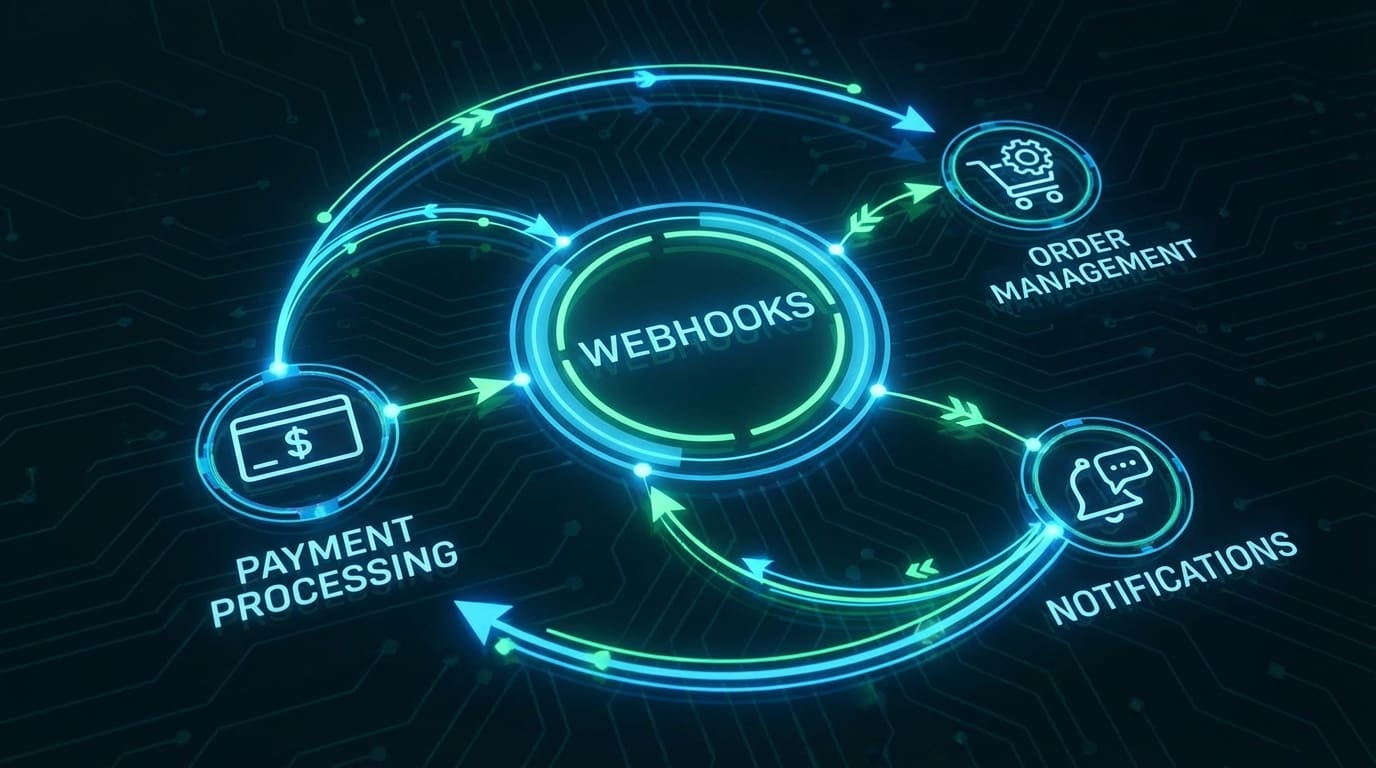
Simple example: A customer completes payment on your e-commerce platform → Payment processor sends a webhook to your inventory system → Inventory automatically updates → Customer receives confirmation email—all in seconds, no manual steps required.
Why Webhooks Are Essential
- Real-Time: Events trigger immediately, not after polling intervals
- Efficient: No wasted API calls or server resources on constant checking
- Scalable: Grows naturally without exponential overhead
- Cost-Effective: Fewer API calls = lower infrastructure costs
- Simple: Straightforward HTTP POST requests, easy to implement
Common 2025 Use Cases
- Payment Processing: Order confirmation → Inventory update → Email notification instantly
- Marketing Automation: Form submission → Add to CRM → Trigger email sequence immediately
- Project Management: Task completed → Update team status → Slack notification instantly
- CRM Integration: Lead captured → Create contact → Assign to sales rep automatically
- Content Distribution: Article published → Post to social media → Update CDN instantly
How Webhooks Work: The Mechanics
The Webhook Lifecycle
- Event Trigger: Something happens in the source system (order placed, file uploaded, user registered)
- HTTP POST Request: Source system creates an HTTP POST with event data
- Data Delivery: Request sent to your configured webhook URL endpoint
- Processing: Your application receives, validates, and processes the data
- Response: You return HTTP 200 OK to confirm receipt
- Action: Downstream effects occur (email sent, database updated, notification posted)
Real-World E-Commerce Example
Customer completes payment at checkout → Payment processor detects payment success → Sends webhook POST to your endpoint https://yourdomain.com/webhooks/payment-completed with order data → Your system receives and validates → Inventory system updates stock → Email service sends confirmation → Shipping system gets notified → All automated, instantaneous
Webhook Payload Structure
Payloads are JSON-formatted data containing event details:
{
  "event_type": "order.created",
  "timestamp": "2025-01-15T14:32:18Z",
  "order_id": "ORD-2025-001234",
  "customer": {
    "id": "CUST-98765",
    "email": "[email protected]"
  },
  "items": [{"product_id": "PROD-456", "quantity": 2}],
  "total": 99.98
}
Implementing Webhooks: Step by Step
Step 1: Create Your Webhook Endpoint
This is a specific URL route that receives incoming webhook POST requests. Here’s a minimal implementation:
Node.js/Express Example:
const express = require('express');
const app = express();
app.use(express.json());

app.post('/webhooks/payment', async (req, res) => {
  try {
    const { order_id, customer_email, amount } = req.body;

    // Validate webhook signature
    if (!verifySignature(req)) {
      return res.status(401).send('Unauthorized');
    }

    // Respond immediately
    res.status(200).json({ received: true });

    // Process asynchronously
    setImmediate(() => {
      updateInventory(order_id);
      sendConfirmationEmail(customer_email);
      notifyShippingDepartment(order_id);
    });

  } catch (error) {
    console.error('Webhook error:', error);
    res.status(500).send('Error processing webhook');
  }
});

app.listen(3000);
Step 2: Configure the Source Application
In your webhook provider’s dashboard (Stripe, Shopify, GitHub, etc.):
- Navigate to webhook settings
- Enter your endpoint URL:
https://yourdomain.com/webhooks/payment - Select which events trigger webhooks
- Configure authentication (secret token, signing key)
- Test the connection with a sample webhook
Step 3: Validate and Verify
Always verify webhooks are legitimate using signature verification:
const crypto = require('crypto');

function verifySignature(req) {
  const signature = req.headers['x-webhook-signature'];
  const secret = process.env.WEBHOOK_SECRET;

  const computed = crypto
    .createHmac('sha256', secret)
    .update(JSON.stringify(req.body))
    .digest('hex');

  return crypto.timingSafeEqual(
    Buffer.from(signature),
    Buffer.from(computed)
  );
}
Security Best Practices for Webhooks
1. Always Use HTTPS
Never accept webhooks over unencrypted HTTP. Require TLS 1.2+ with strong ciphers.
2. Verify Webhook Signatures
Use HMAC-SHA256 to verify requests come from the expected source:
- Provider signs payload with shared secret
- You compute signature with same secret
- Compare using timing-safe comparison (prevents timing attacks)
3. Validate Payload Structure
Check that incoming data matches expected schema before processing:
const Joi = require('joi');

const payloadSchema = Joi.object({
  event_type: Joi.string().required(),
  order_id: Joi.string().required(),
  customer_email: Joi.string().email().required(),
  amount: Joi.number().positive().required()
});

const { error, value } = payloadSchema.validate(req.body);
if (error) throw new Error(`Invalid payload: ${error.message}`);
4. Implement IP Whitelisting (If Available)
Restrict webhook delivery to known provider IP addresses when available:
const ALLOWED_IPS = ['192.0.2.1', '198.51.100.0/24'];

function isAllowedIP(requestIP) {
  return ALLOWED_IPS.some(allowed => {
    return matchesIPRange(requestIP, allowed);
  });
}
5. Rate Limiting
Protect endpoints from abuse with rate limits (e.g., 1000 requests/hour per IP):
const rateLimit = require('express-rate-limit');

const limiter = rateLimit({
  windowMs: 60 * 60 * 1000, // 1 hour
  max: 1000, // 1000 requests per hour
  message: 'Too many webhook requests'
});

app.post('/webhooks/:type', limiter, handleWebhook);
6. Secure Secret Storage
Never hardcode secrets. Use environment variables or secret management systems:
// GOOD
const secret = process.env.WEBHOOK_SECRET;

// BAD - Don't do this!
const secret = 'my-super-secret-key-12345';
7. Comprehensive Logging
Log all webhook requests for security auditing and troubleshooting (without exposing sensitive data):
logger.info({
  timestamp: new Date().toISOString(),
  eventType: req.body.event_type,
  sourceIP: req.ip,
  status: 'received',
  signatureValid: verified
});
Critical Webhook Patterns and Design
Pattern 1: Idempotency (Handle Duplicates)
Webhooks may be delivered multiple times. Ensure safe duplicate processing:
async function processWebhookIdempotently(webhook) {
  const eventId = webhook.event_id;

  // Check if already processed
  const existing = await db.webhookEvents.findOne({ eventId });
  if (existing) {
    console.log(`Event ${eventId} already processed`);
    return;
  }

  // Process event
  await processOrder(webhook.order);

  // Record as processed
  await db.webhookEvents.insert({ eventId, processedAt: new Date() });
}
Pattern 2: Quick Response + Async Processing
Always respond within 10 seconds. Process complex logic asynchronously:
app.post('/webhooks/payment', async (req, res) => {
  // Respond IMMEDIATELY
  res.status(200).json({ received: true });

  // Process asynchronously (don't wait for this)
  processPaymentAsync(req.body).catch(err => {
    logger.error('Async processing failed:', err);
  });
});
Pattern 3: Retry with Exponential Backoff
Providers typically retry failed deliveries with increasing delays:
Failed → retry after 1min → retry after 5min → retry after 30min → give up
Design your endpoint to be idempotent so retries are safe.
Pattern 4: Event Sourcing
Store all webhook events as immutable records for audit trails and replay:
async function storeAndProcessWebhook(webhook) {
  // 1. Store raw event
  const event = await eventStore.append({
    id: generateId(),
    type: webhook.event_type,
    payload: webhook,
    receivedAt: new Date(),
    processed: false
  });

  // 2. Process
  try {
    await processEvent(event);
    await eventStore.markProcessed(event.id);
  } catch (error) {
    await eventStore.markFailed(event.id, error);
  }
}
Common Webhook Issues and Solutions
Issue 1: Webhooks Not Arriving
Check:
- Is URL correct and publicly accessible?
- Is HTTPS certificate valid?
- Is firewall allowing inbound traffic on port 443?
- Is your application running?
- Did you verify with provider test button?
Debug: Use curl https://yourdomain.com/webhooks/test -X POST -d '{"test":true}'
Issue 2: Timeouts and Failed Deliveries
Solutions:
- Respond with 200 OK within 10 seconds
- Move heavy processing to background jobs
- Use message queues (RabbitMQ, Redis) for reliable processing
- Scale up server resources
Issue 3: Duplicate Webhook Processing
Solutions:
- Implement idempotency checks (use event IDs)
- Use database unique constraints
- Track processed event IDs
Issue 4: Authentication Failures
Check:
- Is secret key configured correctly?
- Is signature algorithm matching provider’s method?
- Is body encoding consistent (JSON string vs. raw)?
Issue 5: Payload Parsing Errors
Ensure:
- Content-Type: application/json header handling
- Payload schema validation
- Graceful error handling for malformed data
Monitoring and Observability
Key Metrics to Track
- Success Rate: % of webhooks processed successfully (target: 99%+)
- Processing Latency: Time from receipt to completion (p95, p99)
- Error Rate: Count and categorization of failures
- Throughput: Webhooks processed per minute
Example Prometheus Instrumentation
const promClient = require('prom-client');

const webhookCounter = new promClient.Counter({
  name: 'webhooks_received_total',
  help: 'Total webhooks received',
  labelNames: ['event_type', 'status']
});

const webhookDuration = new promClient.Histogram({
  name: 'webhook_duration_seconds',
  help: 'Processing duration',
  labelNames: ['event_type'],
  buckets: [0.1, 0.5, 1, 5, 10]
});

app.post('/webhooks/:type', async (req, res) => {
  const start = Date.now();
  try {
    await processWebhook(req.body);
    webhookCounter.inc({ event_type: req.params.type, status: 'success' });
    res.status(200).json({ ok: true });
  } catch (error) {
    webhookCounter.inc({ event_type: req.params.type, status: 'error' });
    res.status(500).json({ error });
  } finally {
    webhookDuration.observe(
      { event_type: req.params.type },
      (Date.now() - start) / 1000
    );
  }
});
What to Log
- Timestamp and unique request ID
- Event type and source
- Success/failure and processing duration
- Error messages (without sensitive data)
- Source IP and signature validation result
Set Up Alerts
- Critical: Success rate < 90%, complete outage
- Warning: Success rate < 95%, latency spike
- Info: Unusual traffic patterns
Advanced Webhook Architectures
Fan-Out Pattern
One webhook triggers multiple downstream actions in parallel:
async function handleOrderWebhook(payload) {
  const actions = [
    updateInventory(payload),
    sendConfirmationEmail(payload),
    notifyShippingDept(payload),
    logAnalytics(payload)
  ];

  // Execute in parallel
  await Promise.allSettled(actions);
}
Circuit Breaker Pattern
Protect downstream systems from cascading failures:
class CircuitBreaker {
  constructor(threshold = 5, timeout = 60000) {
    this.failures = 0;
    this.threshold = threshold;
    this.timeout = timeout;
    this.state = 'CLOSED'; // CLOSED, OPEN, HALF_OPEN
  }

  async execute(fn) {
    if (this.state === 'OPEN') {
      throw new Error('Circuit breaker is OPEN');
    }

    try {
      const result = await fn();
      this.failures = 0;
      return result;
    } catch (error) {
      this.failures++;
      if (this.failures >= this.threshold) {
        this.state = 'OPEN';
        setTimeout(() => { this.state = 'HALF_OPEN'; }, this.timeout);
      }
      throw error;
    }
  }
}
Queue-Based Processing
Use message queues for high-volume webhooks:
const queue = new BullQueue('webhooks');

app.post('/webhooks/:type', async (req, res) => {
  // Acknowledge immediately
  res.status(202).json({ accepted: true });

  // Queue for async processing
  await queue.add('process', req.body);
});

// Process messages from queue
queue.process(async (job) => {
  await processWebhookPayload(job.data);
});
Real-World Implementation Checklist
Before Going Live:
- [ ] Implement HTTPS-only endpoints
- [ ] Add signature verification
- [ ] Validate payload schemas
- [ ] Implement idempotency (event IDs, dedup checks)
- [ ] Add comprehensive error handling
- [ ] Set up logging and monitoring
- [ ] Implement rate limiting
- [ ] Test with provider’s test button
- [ ] Test failure scenarios (timeouts, invalid data)
- [ ] Load test with expected volume
- [ ] Document webhook handling in your API
- [ ] Set up alerts for failures
- [ ] Create runbook for troubleshooting
- [ ] Plan for retry handling
Conclusion
Webhooks are essential for modern, real-time application architecture. By understanding their mechanics and implementing them with security and reliability in mind, you can build robust integrations that scale with your business.
Key Takeaways:
- Webhooks push data instantly when events occur (vs. polling)
- Always use HTTPS, verify signatures, and validate payloads
- Respond quickly (< 10sec) and process asynchronously
- Implement idempotency to handle duplicates safely
- Monitor success rates, latency, and error patterns
- Use patterns like circuit breakers and fan-out for reliability
- Test thoroughly before production deployment
The Future: Webhooks are evolving with standards like CloudEvents, improved security practices, and better developer tooling. Staying current with best practices ensures your integrations remain secure and reliable as technology advances.
Start simple, monitor carefully, and iterate based on real-world usage. With webhooks properly implemented, your applications will communicate in real-time with reliability and efficiency.