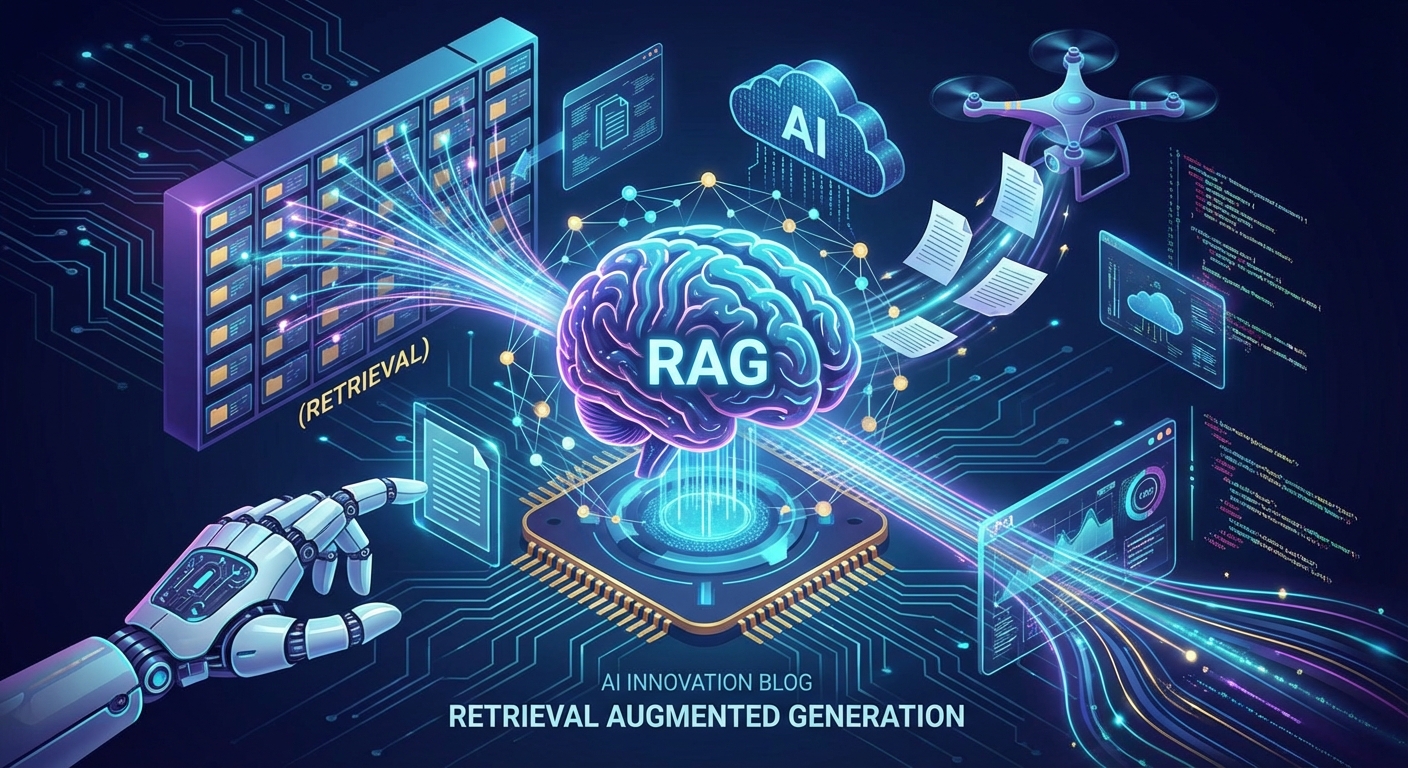
Overview of Retrieval Augmented Generation in AI and Automation
Introduction to the Concept
The AI landscape is evolving at breakneck speed, and staying ahead means understanding the innovations that are reshaping how machines think and create. Enter Retrieval Augmented Generation, or RAG—a breakthrough approach that’s transforming everything from customer service chatbots to enterprise content creation.
So what exactly makes RAG special? At its core, RAG merges two powerful AI paradigms into one cohesive system. Retrieval models excel at searching through massive databases to find and extract precisely the information needed. Generative models, meanwhile, specialize in creating new, coherent content from scratch. By combining these capabilities, RAG produces outputs that are not only creative and well-written but also grounded in factual, relevant data.
Consider a practical scenario: you’re tasked with writing an article about the latest automation trends. A traditional generative model might produce fluent text, but it could include outdated information or even fabricate details. A RAG system takes a different approach—it first retrieves the most current articles, research papers, and industry data available, then uses this information as context for generation. The result? A well-informed, comprehensive article anchored in real-world data that readers can trust.
Importance of Retrieval Augmented Generation
The significance of RAG in AI and automation extends far beyond technical novelty. This technology addresses fundamental challenges that have long plagued AI systems, making it increasingly essential for forward-thinking organizations.
Enhanced Quality of Output: By integrating relevant retrieved data, RAG systems deliver outputs that balance creativity with factual accuracy. This proves particularly valuable in fields where precision is non-negotiable—healthcare diagnostics, financial analysis, and educational content all benefit from this grounded approach to generation.
Efficiency in Content Creation: Time is money, and RAG delivers substantial savings on both fronts. Organizations can automate content generation without sacrificing quality, freeing teams to focus on strategy, analysis, and creative direction rather than getting mired in repetitive content tasks.
Personalization at Scale: RAG enables unprecedented customization based on user preferences and interaction history. A RAG-powered chatbot can retrieve information relevant to your previous queries and generate responses tailored specifically to your context—creating genuinely engaging, individualized experiences.
Scalability Without Compromise: As businesses grow, content demands multiply. RAG allows organizations to scale their content efforts proportionally without expanding headcount. Whether producing blog posts, social media updates, customer emails, or technical documentation, RAG maintains quality across channels.
However, implementing RAG requires careful consideration. The quality of retrieved information directly impacts output quality—poor or irrelevant source data will produce subpar results. Building a robust retrieval mechanism that truly understands context and relevance remains crucial for RAG success.
In essence, Retrieval Augmented Generation represents a pivotal advancement in AI capabilities. By effectively merging retrieval and generative strengths, it offers organizations a powerful toolkit for enhanced content creation, operational efficiency, and meaningful personalization. As we continue exploring AI and automation, embracing RAG could be among your most strategic decisions for staying competitive.
Understanding AI Retrieval Models
Basic Principles of Retrieval Models
With RAG’s fundamentals established, let’s examine the foundation that makes it work—AI retrieval models. These systems efficiently locate and fetch information from vast datasets, serving as the backbone for countless AI applications.
Retrieval models operate on several interconnected principles:
Information Retrieval (IR): This core principle focuses on identifying and retrieving relevant data from massive information pools based on user queries. Think of it as finding a specific book in a library containing millions of volumes—the goal is pinpointing exactly what you need.
Query Representation: When you submit a search query, it must be translated into a format the retrieval system can process. This involves parsing the query, identifying key terms, and determining user intent. Effective query representation directly impacts result relevance.
Document Representation: Every document in the dataset must similarly be encoded in searchable format. This typically means converting documents into vectors or scores reflecting their relevance to various potential queries.
Ranking: Once candidate documents are retrieved, they’re ranked by relevance to the input query. Higher-ranked documents appear first, while less relevant results are filtered out, ensuring users receive the most pertinent information.
Here’s how this works in practice: imagine searching for chocolate cake recipes. Behind the scenes, the retrieval model identifies key terms (chocolate, cake, recipe), searches through thousands of potential recipes, then sorts and ranks results based on how closely they match your request—delivering the most aligned options at the top.
Types of Retrieval Models in AI
Understanding the query-to-result journey is essential, but equally important is knowing the different retrieval model types available. Each offers unique strengths suited to specific applications.
Boolean Retrieval Model: Using Boolean logic (AND, OR, NOT) to match queries to documents, this model is straightforward but can be too rigid for nuanced searches. Searching “chocolate AND cake” returns only documents containing both terms—nothing more, nothing less.
Vector Space Model: This approach represents documents and queries as vectors in multidimensional space, computing similarity using cosine similarity. This flexibility means a “cake recipe” search can return documents about various cake types that still provide valuable information, even if they don’t match exact terms.
Probabilistic Retrieval Model: By estimating the probability of relevance between documents and queries, this model handles complex searches more sophisticatedly. Techniques like BM25 assign relevance scores, making this approach particularly effective for large databases with diverse content.
Neural Information Retrieval: Leveraging machine learning and deep learning techniques, neural retrieval models understand context and semantics at a deeper level. By using embeddings, neural networks capture relationships between topics, delivering remarkably relevant results for intricate queries. This approach powers many modern search engines.
Here’s a comparison of these approaches:
| Retrieval Model | Approach | Strengths | Limitations |
|---|---|---|---|
| Boolean Retrieval | Logic-based | Simple, predictable results | Rigid, limited to exact matches |
| Vector Space | Vector-based | Flexible similarity measurement | May miss contextually relevant documents |
| Probabilistic | Probability-based | Handles uncertainty effectively | Complex implementation |
| Neural IR | Deep Learning | High accuracy, contextual understanding | Requires extensive training data |
Understanding these retrieval models equips you to leverage RAG’s full potential. With this knowledge, you can apply retrieval capabilities effectively, enhancing business outcomes as you adapt to the evolving automation landscape.
Augmented Generation Techniques
Exploring Generative Models
Having examined how retrieval models operate, let’s turn to their creative counterpart—generative models. These systems don’t just find existing content; they create something new. This opens exciting possibilities for businesses seeking to innovate and differentiate their offerings.
Generative models employ various algorithms to produce outputs from inputs—whether text, images, or even music. The most influential techniques include:
Transformers: These models have revolutionized generative AI. Architectures like OpenAI’s GPT (Generative Pre-trained Transformer) use attention mechanisms to weigh each word’s relevance within a sentence, generating contextually rich, naturally flowing text. When each sentence connects seamlessly to the previous one, that’s transformer technology at work.
Variational Autoencoders (VAEs): Primarily used for image generation and discovering latent data representations, VAEs compress data into lower-dimensional space before decoding it back to higher dimensions. This proves essential for creative tasks like generating unique artwork or designing fashion trends.
Generative Adversarial Networks (GANs): GANs consist of two neural networks in creative tension—a generator creates new content while a discriminator evaluates its realism. This back-and-forth continues until the generator produces outputs indistinguishable from real data. Fashion brands already use GANs to create realistic fabric designs and virtual models.
Understanding these generative techniques matters because they empower businesses to create unique offerings, engage users more deeply, and stand out in crowded markets. A content agency, for instance, might use GPT to generate drafts rapidly while maintaining quality through human editing and refinement.
Integrating Retrieval in Generation Models
While generative models produce impressive outputs independently, their potential multiplies when integrated with retrieval models—forming Retrieval Augmented Generation. Here’s how this integration works and why it matters for businesses:
Contextual Awareness: By incorporating relevant retrieved information, generative models produce content that’s both creative and factually grounded. This proves essential in industries where accuracy is paramount. A healthcare chatbot generating responses with medical information must utilize the latest research—RAG makes this possible.
Enhanced Coherence: When a generative model retrieves relevant documents first, it better understands the information context it’s generating. This produces more coherent, informed responses. A user asking about “sustainable fashion” receives insights drawn from data on eco-friendly brands, current trends, and sustainability statistics.
Personalization: Integrating retrieval allows generative models to adapt outputs based on user preferences. A RAG-powered recommendation system fetches past user interactions and generates tailored suggestions—imagine a music streaming service suggesting playlists based not just on algorithms, but on your actual listening history.
Efficiency: This integration streamlines content creation significantly. When marketers use RAG, they automatically generate drafts enriched with curated information, dramatically reducing initial research time. It’s like having a research assistant that pulls necessary data while you focus on crafting the perfect message.
The RAG workflow follows a clear path: Input (user query) → Retrieval Phase (fetching relevant documents) → Generation Phase (creating content from retrieved context) → Output (coherent, contextually enriched response).
Generative models offer remarkable creative capabilities, but the real power emerges when these models integrate with retrieval systems to enhance relevance, coherence, and personalization. This combination makes AI applications more effective while significantly improving user engagement and satisfaction.
Applications of Retrieval Augmented Generation
Text Generation in Natural Language Processing
With RAG’s foundational principles and integration mechanics established, let’s explore real-world applications. Natural Language Processing represents one of RAG’s most impactful domains.
RAG-powered text generation involves creating coherent, contextually relevant content—from single sentences to complete documents—based on user queries. Here are standout applications:
Chatbots and Virtual Assistants: RAG dramatically enhances conversational AI. These systems retrieve information based on user inquiries and generate natural-sounding responses. When you ask a virtual assistant about weather, it retrieves the latest forecast and crafts a conversational, friendly response—not a robotic data dump.
Content Creation for Marketing: Businesses constantly need high-quality written content across blogs, social media, and newsletters. RAG enables marketers to generate engaging copy tailored to current trends. A marketing team providing a brief on spring fashion trends can receive a blog post that incorporates recent articles and insights, resonating authentically with their audience.
Language Translation: RAG enhances machine translation by retrieving context-specific translations rather than just converting words between languages. This ensures idiomatic phrases retain their intended meaning—”kick the bucket” gets translated to an equivalent idiom rather than literal nonsense about footwear and containers.
Creative Writing: For authors, RAG tools serve as inspiring collaborators. Writing a science fiction novel? Ask for ideas on alien civilizations based on current scientific theories, and RAG retrieves relevant documents to help generate plot lines and character development grounded in real science.
Across these applications, RAG proves transformative for text generation, giving businesses and creators the ability to produce valuable content efficiently and accurately.
Image Generation in Computer Vision
Beyond text, RAG makes significant strides in image generation within computer vision. The fusion of retrieval and generative technologies creates powerful tools driving creativity and innovation across industries.
Art and Design: Artists can input ideas into a system that retrieves related works or styles, then generates unique pieces blending those inspirations. Want a landscape combining Impressionism with modern abstract? The system retrieves examples of both styles and generates something that merges elements from each tradition.
Content Creation for Social Media: Social platforms demand constant fresh visuals. Using RAG, businesses generate eye-catching images by retrieving trending styles or popular themes. A food delivery service might generate vibrant images of new menu items, pulling in styles from popular food photography to maximize appeal.
Fashion Design: The fashion industry thrives on creativity, and RAG becomes a designer’s powerful ally. By retrieving current trends, color palettes, and market styles, designers generate new clothing ideas or entire collections aligned with consumer preferences—turning market research into creative inspiration.
Augmented and Virtual Reality: RAG applications extend to AR and VR by retrieving contextual information to create immersive environments. Building a virtual space becomes easier when the system pulls relevant data from various sources to generate realistic landscapes or interactive rooms—imagine exploring a historically accurate virtual city where every detail draws from authentic historical sources.
RAG has unlocked vast possibilities in both text and image generation. By effectively combining retrieval capabilities with generative models, businesses can innovate in ways that enhance engagement and fulfill creative aspirations.
Benefits and Challenges
Advantages of Retrieval Augmented Generation
Having explored RAG’s diverse applications, let’s examine the advantages making this technology compelling for businesses and creators.
Improved Accuracy: Real-time data retrieval ensures generated content remains factually accurate. A healthcare chatbot retrieving the latest medical guidelines before providing advice builds trust through reliable, current information.
Time Efficiency: Content teams facing tight deadlines find RAG transformative. Combining retrieval and generation dramatically accelerates production. A marketing team needing an industry trends report can compile relevant information and generate a meaningful report in a fraction of traditional research time.
Enhanced Engagement: Highly relevant, personalized content significantly increases user engagement. When customers receive marketing messages based on their past interactions, connection rates soar—leading to higher conversions and improved satisfaction.
Creativity Boost: Creative professionals gain an innovative brainstorming partner. When generating ideas for product launches or ad campaigns, access to retrieved data can spark out-of-the-box thinking. A graphic designer exploring past successful campaigns retrieved by RAG fuels unique creative directions.
Scalability: Growing businesses face expanding content needs. RAG enables scaling efforts without proportional quality compromise. Automated processes produce high volumes of content across platforms—social posts to detailed reports—while maintaining standards.
Limitations and Potential Issues
While RAG offers substantial benefits, acknowledging limitations and potential issues remains crucial for successful implementation.
Quality of Retrieved Data: RAG effectiveness depends directly on retrieval quality. Irrelevant or outdated information produces subpar outputs. Organizations must invest in robust data management and retrieval systems prioritizing high-quality, current sources.
Implementation Complexity: Integrating RAG into existing workflows presents technical challenges, especially for organizations lacking specialized expertise. Significant time and resource investments may be required, potentially daunting for smaller teams.
Bias and Fairness: Like many AI systems, RAG models can perpetuate bias from skewed training data. If retrieved data contains systemic biases, generated content reflects these issues, leading to unfair or inaccurate representations. Mindful data sourcing and fairness evaluations are essential.
User Dependency: RAG systems require effective user input. Vague or poorly structured queries produce subpar outputs. Proper training ensures users can maximize system potential through well-crafted queries.
Overreliance on Automation: While automation enhances productivity, it can sometimes diminish human intuition and creativity. Businesses must balance RAG leverage with human oversight to foster genuine innovation.
RAG’s benefits are genuinely transformative—improved accuracy, efficiency, engagement, and scalability. Yet addressing limitations and challenges thoughtfully enables strategic adoption that enhances content generation while navigating potential pitfalls.
Future Trends in AI and Automation
Evolving Technologies in Retrieval Augmented Generation
Looking beyond current capabilities, the future of AI and automation holds exciting possibilities, with RAG positioned to play a pivotal role in shaping technological advancement.
Advancements in Deep Learning: As deep learning techniques progress, RAG systems will become increasingly sophisticated. Enhanced neural networks will enable these systems to understand context and nuance at unprecedented levels. Future RAG models might comprehend humor, sarcasm, and emotional subtlety, generating content that resonates more deeply with users.
Real-Time Data Integration: The ability to incorporate real-time data into RAG systems is becoming increasingly achievable. Imagine generating business reports that incorporate the latest market data updated in real-time—providing organizations with competitive advantages through faster, more informed decision-making.
Multimodal Capabilities: Future RAG may seamlessly incorporate multiple data modes—text, images, and audio combined. A RAG system could generate comprehensive video tutorials by retrieving relevant articles, graphics, and sound clips, creating cohesive outputs that revolutionize education and training.
Enhanced Personalization: Future RAG models will likely leverage user data for even deeper personalization. By analyzing preferences over time, these systems could tailor content generation to individual users with remarkable precision—imagine news feeds that retrieve and generate articles perfectly aligned with your interests and reading patterns.
AI Collaboration: We’re entering an era where AI collaborates with human creators as genuine partners. Imagine writers working alongside RAG systems to brainstorm ideas, with AI pulling relevant concepts and data while humans craft the narrative—a synergy combining human intuition with machine efficiency.
Impact on Industry and Society
RAG and related technologies have profound implications extending far beyond business applications. The way we work, communicate, and access information stands on the brink of significant transformation.
Job Transformation: Rather than simply eliminating jobs, RAG will create new opportunities. Roles will shift from traditional content creation toward overseeing AI systems, ensuring they function effectively and ethically. Organizations might seek AI specialists to manage and refine RAG systems rather than simply hiring more content writers.
Democratization of Knowledge: RAG can democratize high-quality content generation, making it accessible to individuals and small businesses lacking resources for traditional content creation. This could lead to a more informed public and greater diversity in amplified voices across fields.
Ethical Considerations: As RAG technologies evolve, industries and societies must address ethical concerns around data use, privacy, and bias. Balancing innovation with ethical responsibility will be essential for maintaining public trust and avoiding potential misuse.
Enhanced Communication: RAG can bridge language barriers and facilitate cross-cultural communication. Advanced translation capabilities could enable easier international business collaboration and foster global understanding.
Educational Transformation: The education sector will likely see significant transformation through RAG technologies, creating interactive and personalized learning experiences. Students could receive educational content, practice problems, and resources dynamically generated based on their learning pace and style.
The future of Retrieval Augmented Generation is bright, with promising advancements set to redefine content generation and interaction. As these technologies develop, they hold potential for significant positive impact across industries and society. Embracing these changes and adapting to the evolving landscape will be key to thriving in this new era of AI and automation.
Ethical Considerations
Privacy Concerns in AI Retrieval Models
As we embrace RAG’s transformative potential, acknowledging ethical considerations—particularly concerning privacy—becomes essential. These issues stand at the forefront of responsible AI implementation.
Data Collection and Usage: RAG systems rely on vast data quantities to function effectively. This raises critical questions about how user data is collected, stored, and utilized. When AI retrieves personal information to generate tailored content, it must do so without violating privacy rights. Users deserve transparency about what data is collected and how it will be used.
Informed Consent: Obtaining meaningful informed consent is vital for AI applications using personal data. Users should have clear options to opt in or out of data collection processes, maintaining control over their information. A news aggregator personalizing content should clearly inform users about data usage, allowing them to decide whether to permit tracking.
Data Security: Increased data reliance brings responsibility for security. Regular security measures and protocols must protect user information from breaches. Organizations must invest in robust data protection strategies to safeguard against unauthorized access—consequences of failures affect both users and organizations.
Rights to Data Deletion: Users should have the right to delete their data from AI systems at any time. This “right to be forgotten” ensures individuals maintain privacy control. If a user no longer wants their activities tracked by a recommendation system, they should be able to withdraw their data easily and completely.
Addressing these privacy concerns requires proactive approaches, encouraging organizations to adopt ethical data practices prioritizing user rights. As AI evolves, keeping privacy conversations at the forefront ensures technology enhances rather than compromises individual freedoms.
Bias and Fairness in Augmented Generation
Alongside privacy, addressing bias and ensuring fairness represents another critical ethical concern. Since AI models learn from historical data, they can inadvertently perpetuate existing biases.
Sources of Bias: Bias emerges from multiple origins. Data Bias occurs when training data is unbalanced or fails to represent diverse populations—if a model learns primarily from texts reflecting certain cultural perspectives, it may fail to generate content that resonates with or includes other viewpoints. Algorithmic Bias stems from algorithms that prioritize certain patterns over others, leading to skewed results.
Implications for Fairness: Bias in AI-generated content carries real-world consequences. Biased hiring tool algorithms might favor candidates from specific backgrounds while overlooking others, reinforcing societal inequalities. Organizations must recognize bias potential in RAG systems and strive for inclusive, fair content generation practices.
Strategies for Reducing Bias: Implementing effective bias-reduction strategies is essential. Diverse Training Data—actively seeking varied datasets ensures demographic representation and leads to more balanced outputs. Bias Audits—regular assessments of AI outputs help identify and mitigate biases, evaluating how systems perform across different groups. Stakeholder Involvement—engaging diverse groups in AI development brings various perspectives, ensuring generated content meets broader audience needs.
While RAG presents significant innovation opportunities, addressing ethical considerations around privacy and bias remains paramount. By striving for transparency in data usage and ensuring fairness in generated content, organizations can build user trust and foster a more equitable technological landscape. Keeping these ethical considerations at the forefront will be critical for responsible AI development.
Conclusion
Recap of Key Points
As we conclude our exploration of Retrieval Augmented Generation, let’s revisit the key insights from this journey. RAG represents a significant AI advancement, intertwining retrieval and generative models to create highly relevant, context-aware outputs.
Understanding RAG: At its core, RAG combines retrieval models (identifying and extracting relevant information) with generative models (creating new content). This integration enables richer, more informed content generation across text, images, and other formats.
Applications of RAG: We explored diverse applications across text generation—from chatbots to creative writing—and image generation—including art, fashion design, and AR/VR experiences. RAG facilitates engaging, personalized content creation across domains.
Advantages of RAG: Key benefits include improved accuracy, time efficiency, enhanced engagement, creativity support, and scalability. By automating and enriching content generation, RAG empowers businesses to scale efforts while maintaining quality.
Challenges and Ethics: Recognizing challenges—particularly concerning privacy, bias, and implementation complexity—proves essential. Transparent data practices and bias reduction ensure fairness in AI-generated content.
Future Trends: Looking ahead, evolving technologies, multimodal capabilities, and enhanced personalization will redefine how we work and communicate. RAG’s impact on industries and society will be transformative, creating new opportunities for collaboration and innovation.
Final Insights
As we conclude, embracing RAG’s potential for the future is essential. The integration of retrieval and generative capabilities isn’t merely a trend—it’s a transformative shift in how we approach information and creativity.
Adaptability is Key: In a rapidly evolving technological landscape, businesses and individuals must embrace adaptability. Stay informed about RAG advancements, and remain willing to experiment and iterate in your content strategies.
Prioritize Ethics: When implementing RAG technologies, keep ethical considerations at the forefront. Transparency about data usage, proactive bias addressing, and user privacy prioritization build the trust essential for sustained success.
Collaborate with AI: Rather than viewing AI as a replacement for human creativity, consider it a collaborative partner. Working alongside RAG systems amplifies creativity, streamlines processes, and generates ideas that might not surface otherwise.
Invest in Education: The future belongs to those who invest in understanding AI and its applications. Ensure your team possesses the knowledge and skills needed to leverage RAG effectively. Training and upskilling empower organizations to fully harness this technology’s capabilities.
Retrieval Augmented Generation presents an incredible opportunity to enhance how we create, engage with, and distribute content. Moving forward, commitment to ethical practices, continuous learning, and AI collaboration will build a future that is innovative and socially responsible. Embrace the journey, adapt to change, and you’ll be well-positioned to thrive in an increasingly AI-driven world.